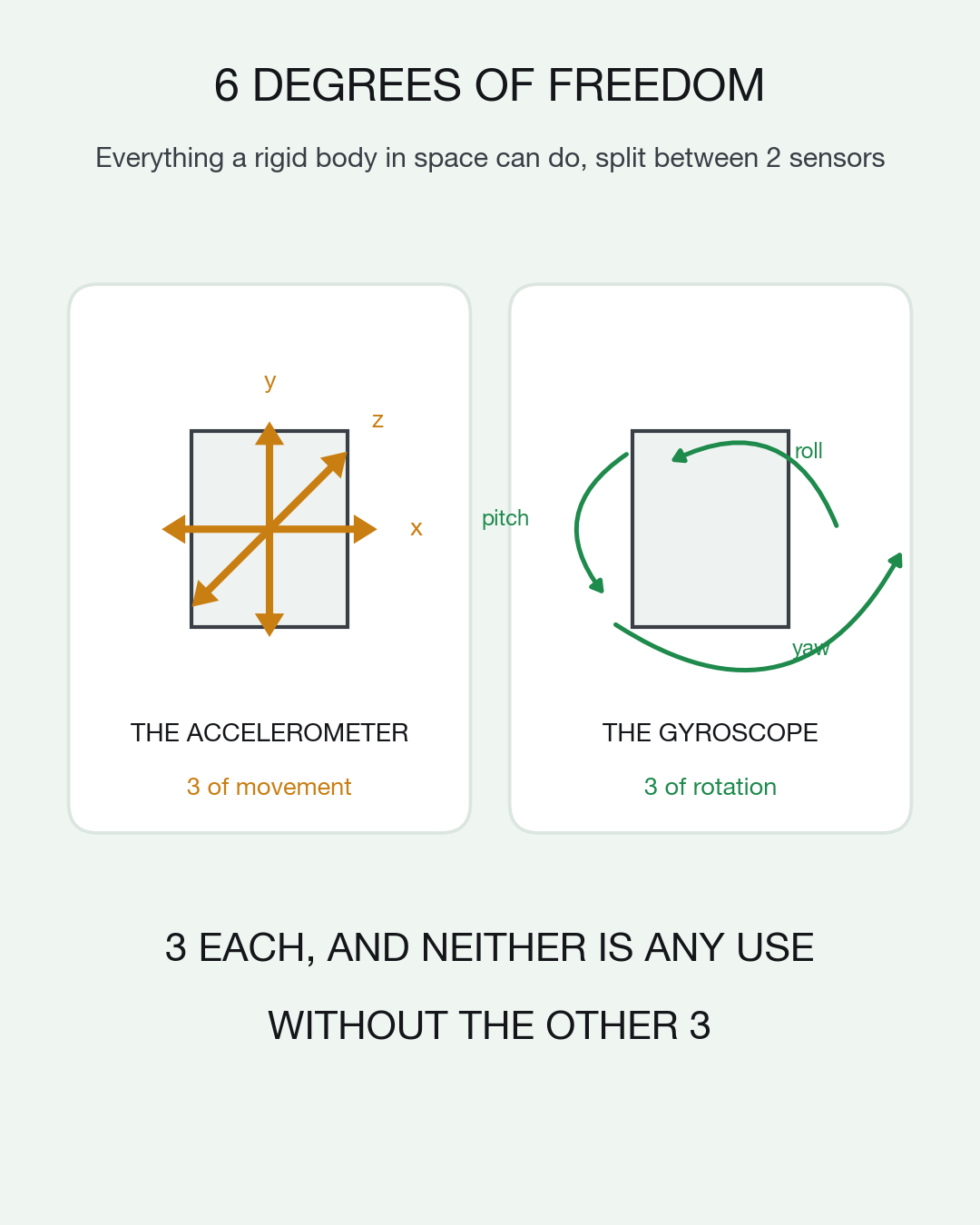
Your phone contains an inertial measurement unit — an IMU — which is 2 sensors that between them measure 6 degrees of freedom: 3 of acceleration, 3 of rotation. The pair costs about $3, and one of the 2 is a crystal in a vacuum.
A gyroscope has no spinning wheel in it
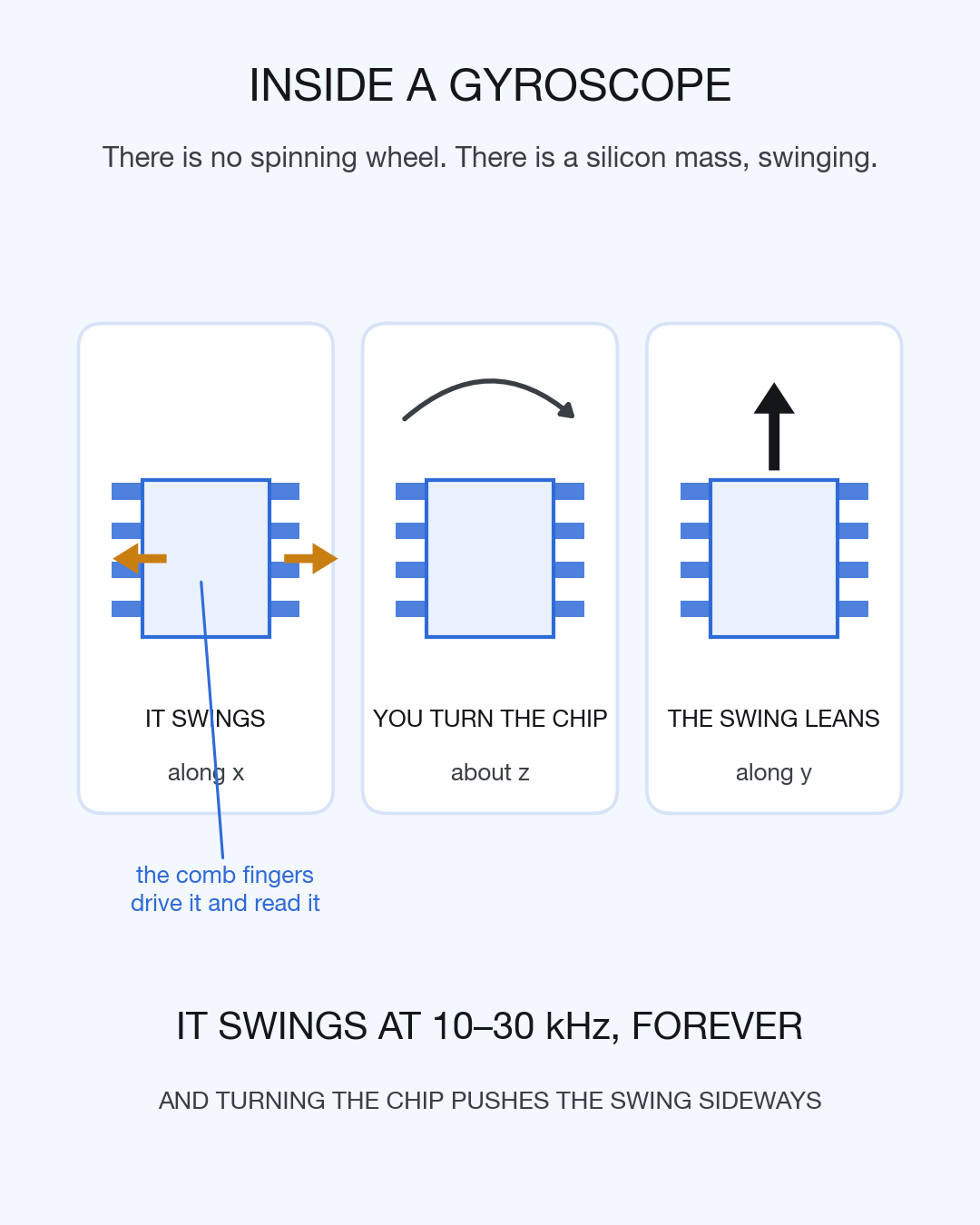
It has a piece of silicon, machined into something close to a tuning fork, sealed in a vacuum and driven to swing at 10–30 kHz for as long as the power is on. It never stops, and it never arrives anywhere.
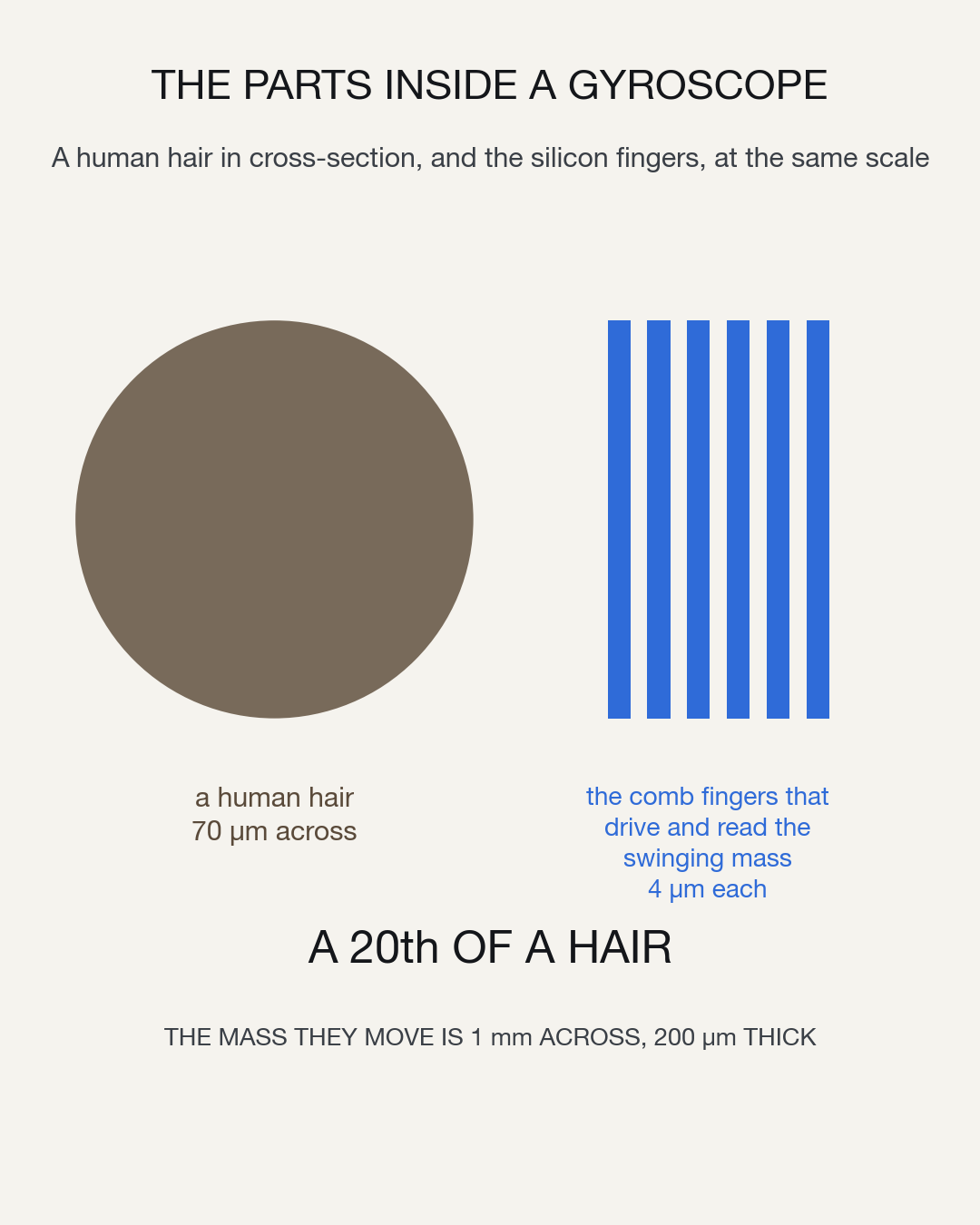
That swinging mass is about 1 mm across and 200 µm thick, or 3 human hairs. The comb of silicon fingers that drives it and reads its position is 4 µm per finger, a 20th of a hair.
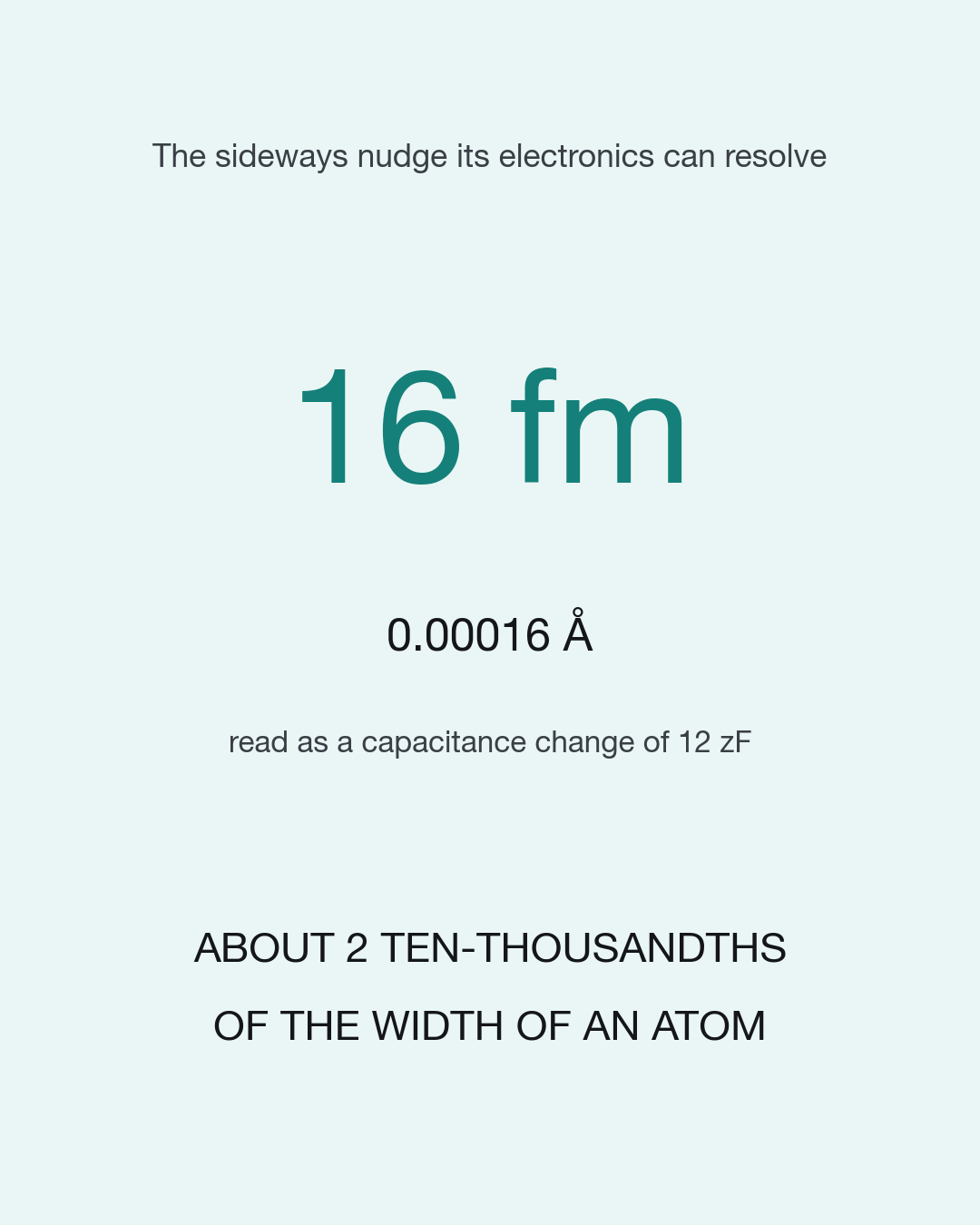
Turn the chip and the Coriolis force — the one that curls a wind as it crosses a spinning planet — pushes the swing sideways, at right angles to both the swing and the axis you turned about. Analog Devices put the deflection their electronics can resolve at 16 fm, about 2 ten-thousandths of the width of an atom, read as 12 zF of capacitance.
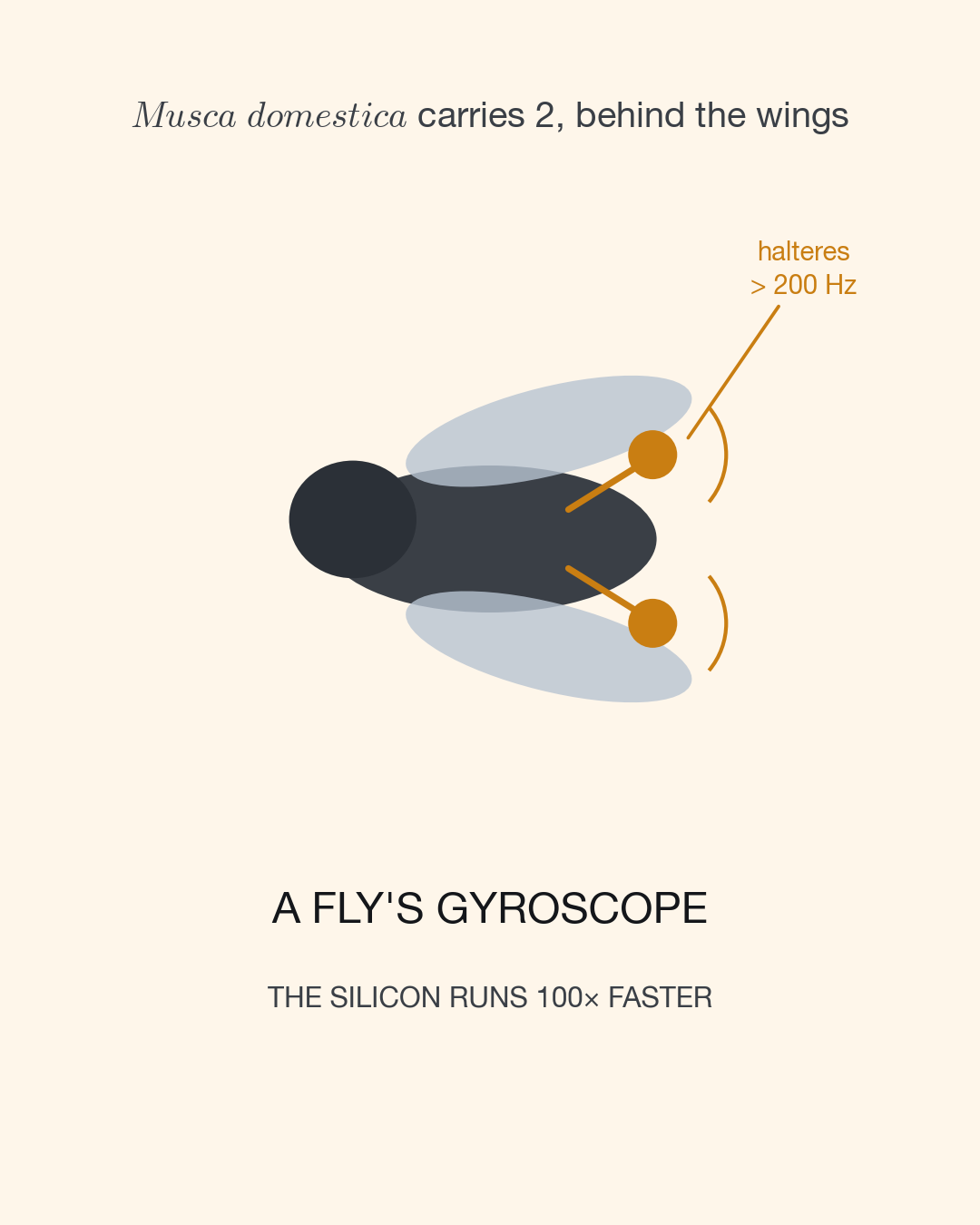
Musca domestica has carried 2 of these for rather longer than we have: the halteres, a pair of small clubs behind the wings, beating at over 200 Hz. Ours runs 100× faster, which is worth remembering the next time one outmanoeuvres you over the fruit bowl.
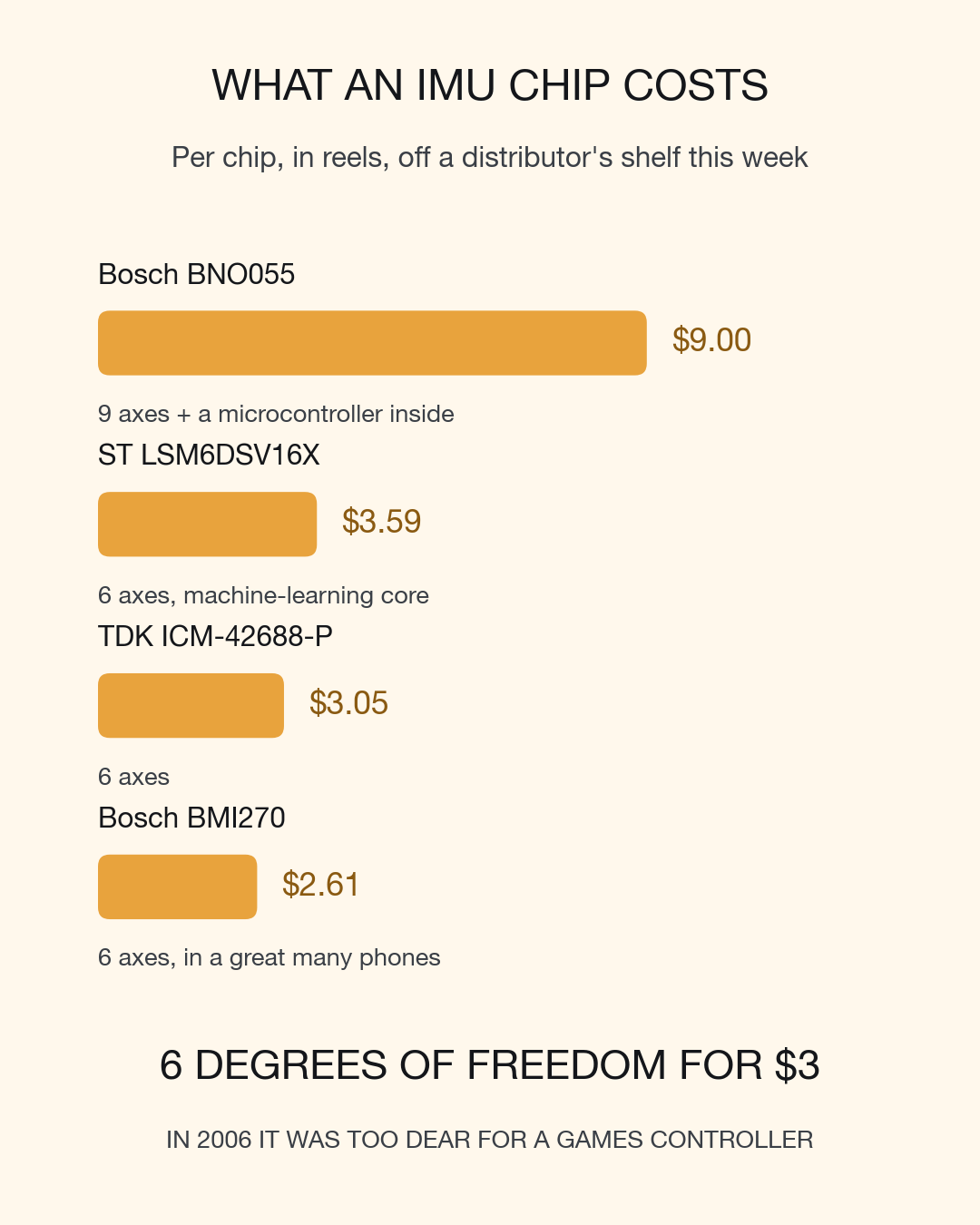
A motion-sensor chip now costs $3
Per chip, in reels, off a distributor’s shelf this week: Bosch BNO055 $9.00 · ST LSM6DSV16X $3.59 · TDK InvenSense ICM-42688-P $3.05 · Bosch BMI270 $2.61. The BNO055 is roughly 3.5× the BMI270, and what that buys is the microcontroller inside it doing the fusion for you, not better sensing.
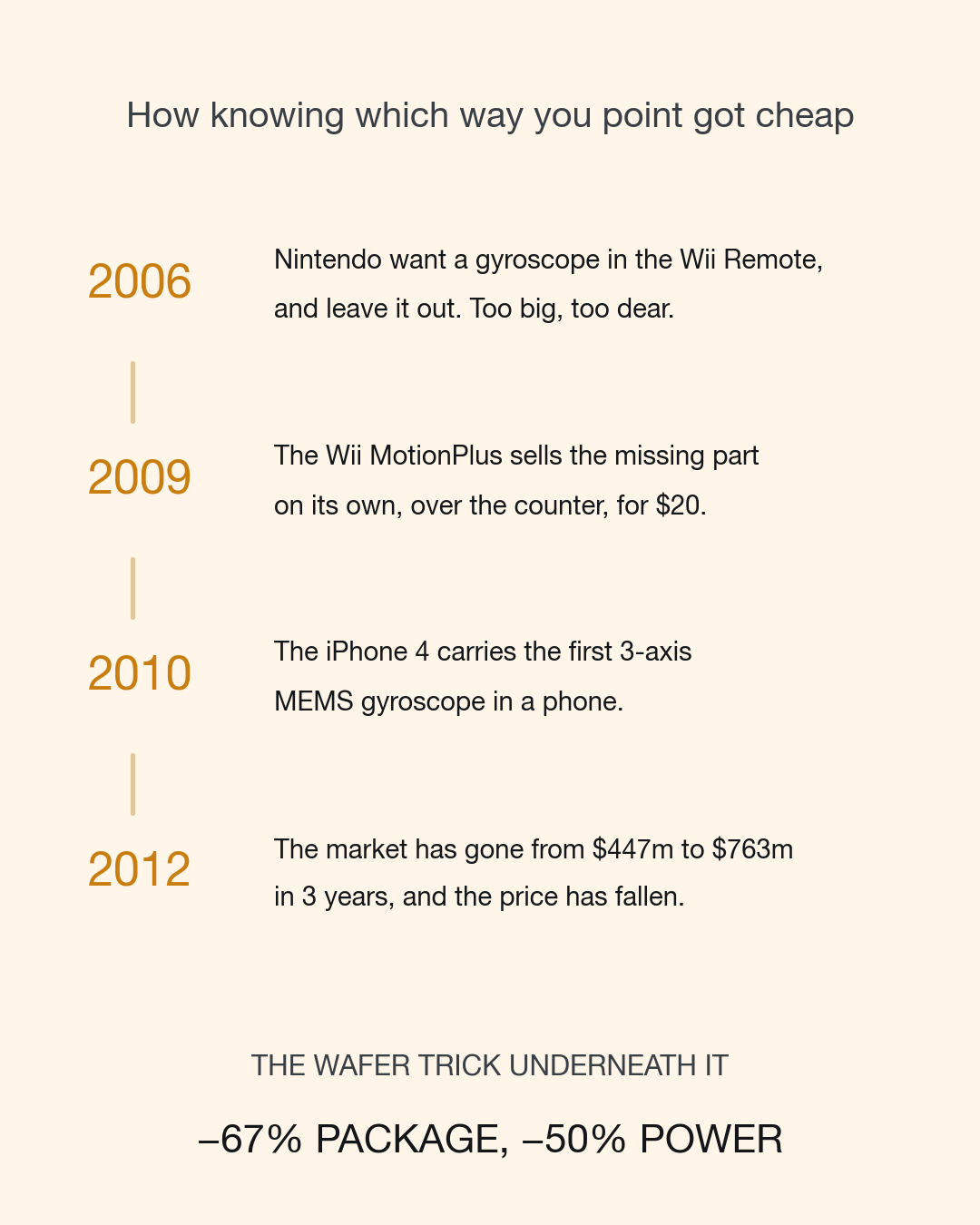
It was not always so. In 2006 Nintendo wanted a gyroscope in the Wii Remote and left it out, on the grounds of both size and cost. By 2009 they could sell you the missing part on its own, over the counter, for $20. The year after that the iPhone 4 carried the first 3-axis MEMS gyroscope in a phone. Underneath all of it was InvenSense’s Nasiri process, which bonds the wafer of silicon machinery straight onto the wafer of electronics, making the electrical connections and sealing the vacuum around the moving parts in a single step: 67% off the package, 50% off the power.
Why a gyroscope needs an accelerometer beside it
An accelerometer cannot tell you what happened to it. Tip it left, or slide it left without tipping it, and gravity slides across its axes much the same way. A force feels identical whether the world pushed you or you simply leaned into it. That is not a defect waiting to be engineered out — it is what the instrument measures.
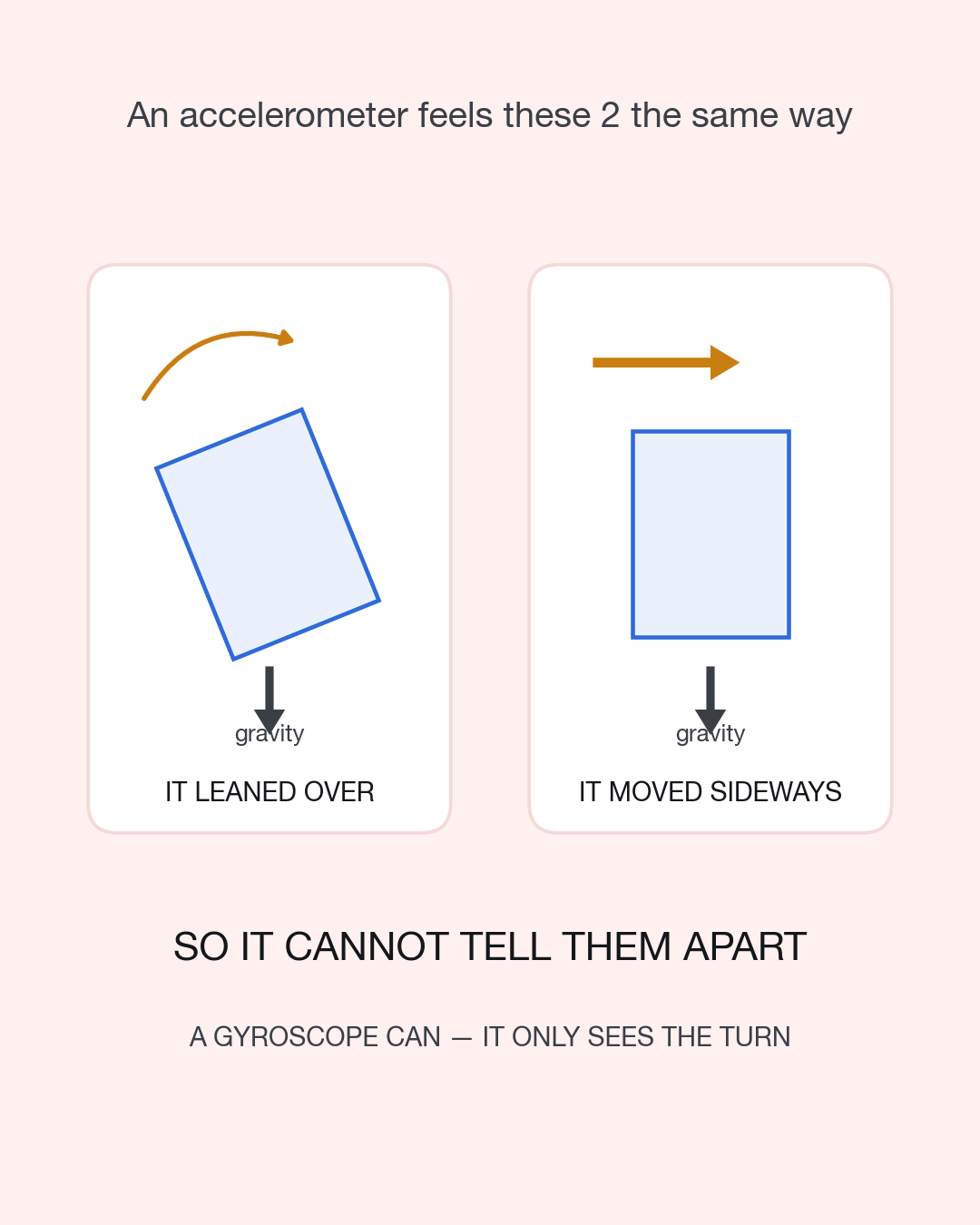
A gyroscope has precisely the opposite blindness. It reports rotation and nothing else, so it will tell you with confidence that you turned through 30° while remaining serenely unaware that you also crossed the room. 3 degrees of freedom each, and neither is any use without the other 3 — which is why they are sold as one chip.
The equation on the bridge
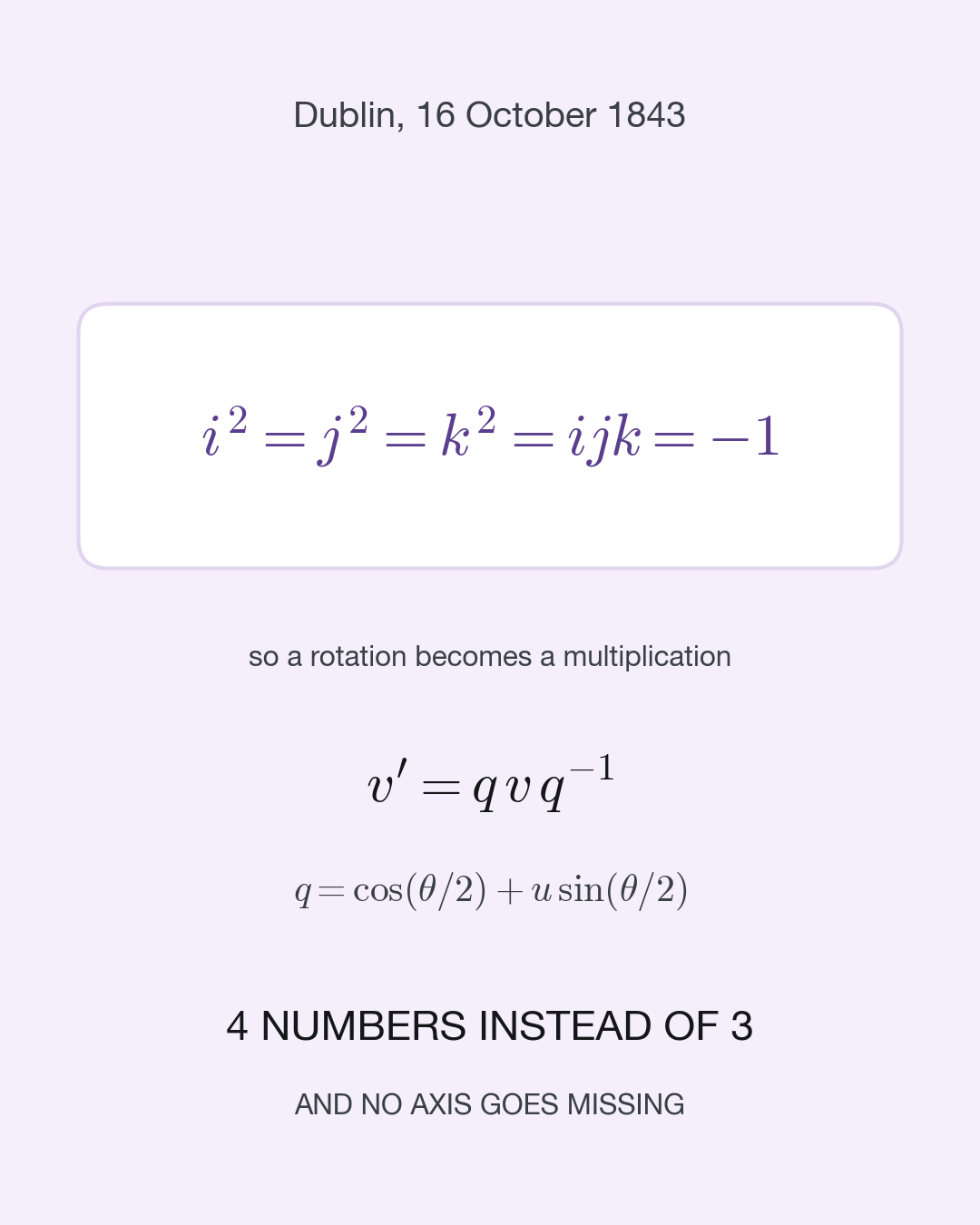
3 angles have a trap in them: swing 1 axis into another and a degree of freedom quietly vanishes. Gimbal lock is not a curiosity — the Apollo guidance platform had a zone the crew had to steer around.
Hamilton found the way out in 1843, stuck on the problem for years, then certain enough on a canal walk in Dublin to stop at Broome Bridge and cut it into the stone. 4 numbers instead of 3, and a rotation becomes a multiplication. Anyone who sat an engineering degree met this at the point in term when it seemed entirely gratuitous. It is not gratuitous. It is what carries the attitude through a stroke without an axis going missing.
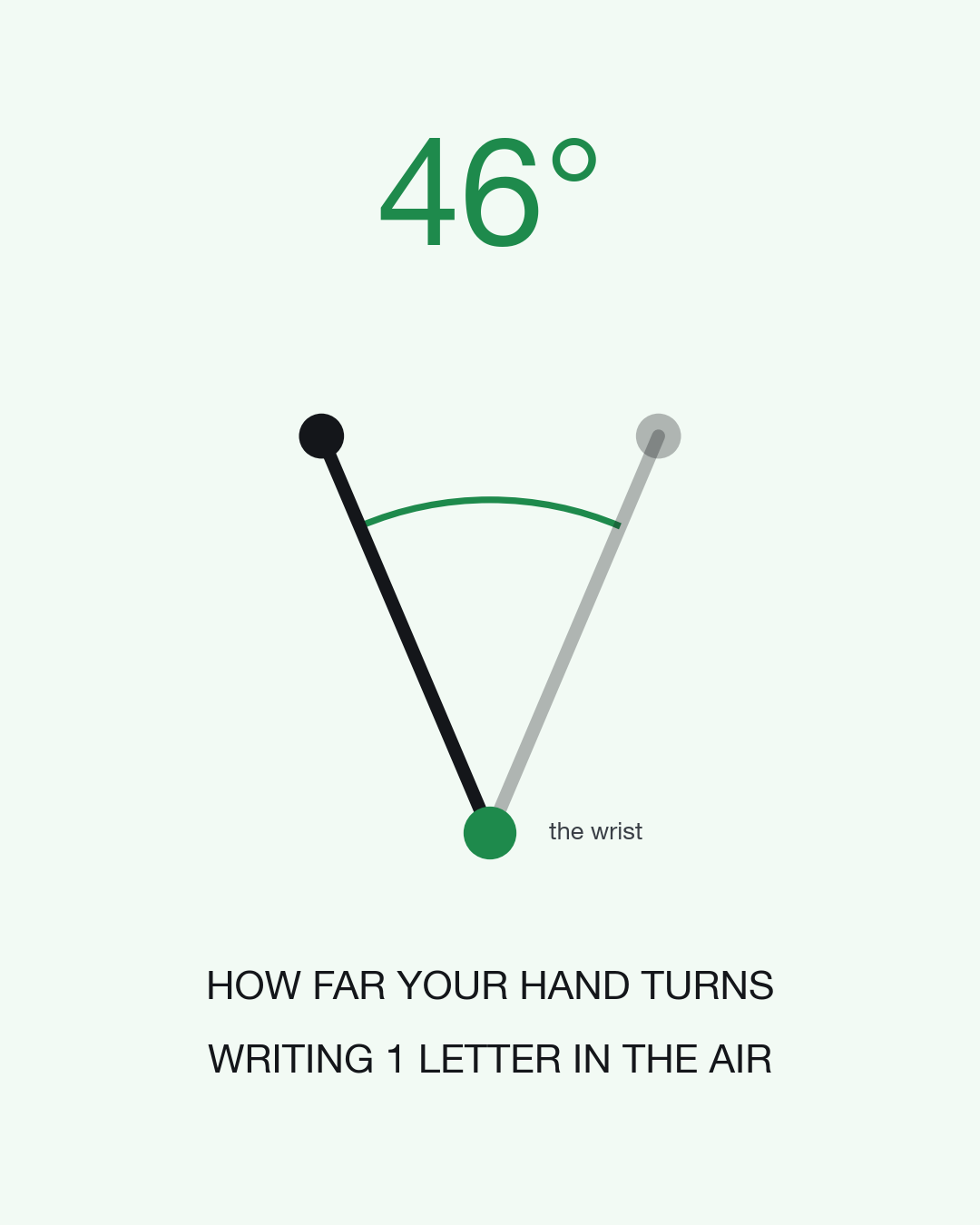
A hand rotates 46° writing a single letter
It feels like drawing on glass, and it is nothing of the sort. We know the number because 450 people on Prolific wrote the alphabet in mid-air for us, using the IMU in their own phones — 52,191 letters in all.
After that it is arithmetic, and quite pretty arithmetic: rotate the measured acceleration into the frame of the room, lift gravity out of it, and add it up twice. The last step is the one worth admiring. The hand is still when the button goes down and still again when it lifts, so whatever speed is left over at the end is error rather than movement, and it can be handed back along the stroke where it came from.
Do this yourself, on your phone
That page is live, and your phone has the same 2 sensors and the same 6 degrees of freedom. Press the square, write a letter in the air, and watch your own path draw itself and then tighten. No app, no account: demo.the-wand.ai/trace
A crystal swinging in a vacuum, so that somebody can write the letter a at a television. It seems a great deal, and it is roughly what the fly is doing.
Where the numbers come from: the 16 fm deflection and the 12 zF of capacitance are Analog Devices' own figures, from New iMEMS Angular-Rate-Sensing Gyroscope in their Analog Dialogue archive. Drive frequencies of 10–30 kHz are the standard range for consumer parts. The hair is 70 µm, the population average. Chip prices were pulled from a distributor's API on 18 September 2026 at reel quantities, converted from euros at 1.1496. The Wii MotionPlus story is Nintendo's own, from the Iwata Asks interviews. The 46°, the 0.84 s a letter takes and the still-point correction are measured across our own casts.